Move capability closer—when you can govern it.
Learn the system, keep the record, make the first version, maintain the flow, or build enough local judgment to act without remaining helpless.
Generation gives agency. It also creates obligation.
Civilization is closer than it looks. Learn to operate more of it.
Dispatched to find civilization inside schools, governments, factories, hospitals, and markets, Professor Yourtle discovers many of its essential functions operating inside ordinary people and households. The result is not a fantasy of independence, but a practical philosophy of capable participation.
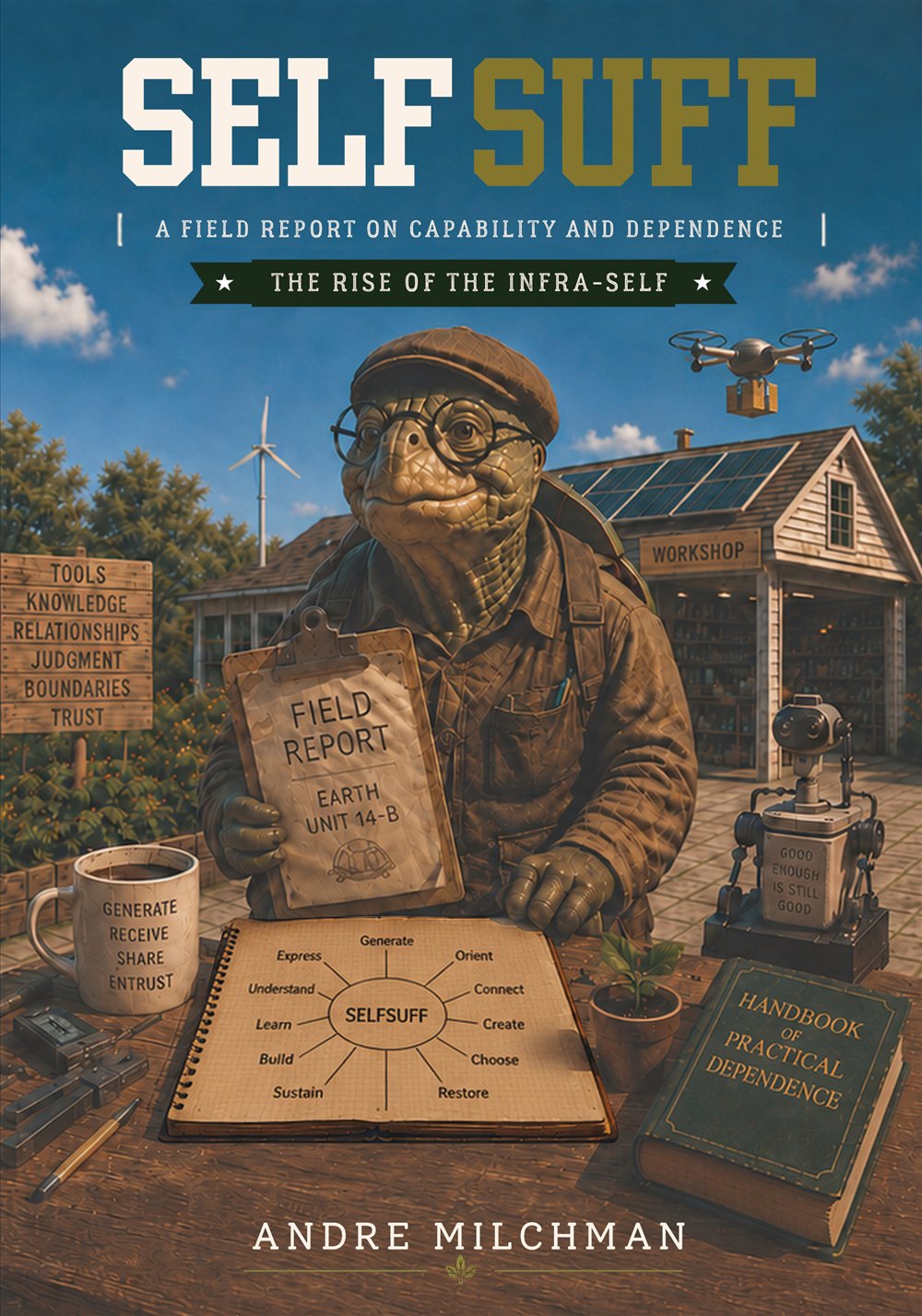
SelfSuff does not ask you to escape civilization, replace professionals, or make a private nation out of your household. It asks a more useful question: Where should capability live, and how should you participate in it?
Build enough capability inside your life to depend on the world more wisely.
The old question asks, “Can I do this myself?” SelfSuff asks which relationship to the capability is wiser: generate it, receive it, share it, or entrust it.
Learn the system, keep the record, make the first version, maintain the flow, or build enough local judgment to act without remaining helpless.
Generation gives agency. It also creates obligation.
Receive expertise, art, food, care, correction, public infrastructure, and other people’s excellence when receipt is safer, kinder, more efficient, or simply better.
Receipt is not defeat. It is often civilization functioning as intended.
Shared tools, shared knowledge, shared care, shared memory, and shared responsibility can create redundancy, belonging, correction, and continuity.
Sharing requires permission, role clarity, maintenance, and a way to handle conflict.
Entrust when safety, scale, licensing, legitimacy, advanced expertise, independent oversight, or public consequence exceeds local authority.
A mature boundary is not helplessness. It is accurate capability.
The report follows civilizational functions that are becoming locally operable through people, households, tools, records, relationships, AI agents, robots, animals, and institutions.
Move from consuming culture and identity to actively shaping them.
Build clearer self-knowledge, stronger inquiry, and better judgment.
Turn ideas into artifacts and recover agency when systems fail.
Sustain bodies, households, resources, and essential flows.
Choose among possible futures while remaining available to others.
Govern capability by what it contributes, protects, and serves.
Professor Yourtle arrives with an orderly civilizational map. Law belongs in courts. Learning belongs in schools. Production belongs in factories. The neighborhood corrects him.
“The neighborhood was not outside civilization. It was civilization, made intimate enough to spray my clipboard.”
Grass became property, water allocation, software scheduling, neighbor memory, municipal runoff, maintenance, child instruction, wildlife disregard, and blame.
Artie Sciencen coordinates tools, records, AI assistance, robots, animals, privacy limits, and neighborhood trust under one accountable human judgment center.
Food, privacy, schedules, animal care, robot policy, evidence, education, household memory, and conflict resolution all became locally operable—sometimes before the toast was finished.
Before internalizing, independently performing, automating, or sharing a function, the report asks six questions. The aim is not timidity. It is accurate capability.
No heroics requiredSelfSuff is written for people who want more capability, more legible dependence, and better boundaries—not lifestyle theater or heroic isolation.
Readers interested in how AI, tools, institutions, households, and human judgment reorganize one another at smaller scales.
People who know that a workshop is not making, a dashboard is not governance, and access to an answer is not understanding.
Anyone who wants essential flows, practical knowledge, and local coordination to become less mysterious without pretending institutions are obsolete.
Serious ideas arrive through an alien field researcher, robots, dogs, cats, hens, breakfast meetings, and unauthorized ecological participation.
The narrative follows two working architectures of the Infra-Self and the observer whose categories keep failing in their presence.
An extraterrestrial sociotechnical anthropologist who arrives with a clipboard—a portable fog of legitimacy—and slowly discovers that ordinary life contains more civilization than his institutional map allowed.
One accountable human center coordinating a dense ecology of tools, records, AI assistance, robots, animals, making, repair, and neighborly contribution. Fast, coherent, capable—and vulnerable to becoming the bottleneck.
Several human judgment centers sharing care, correction, memory, tools, AI agents, robots, animals, and breakfast. Slower than Artie, but more redundant—and harder for one elegant mistake to rule alone.
Andre Milchman is an independent researcher and enterprise and software architect whose work examines sociotechnical systems, artificial intelligence, complex organizations, and the structure of knowledge.
With SelfSuff, that systems inquiry moves to the scale of the person and household: how ordinary people can generate, understand, maintain, and transform more of daily life while remaining connected to specialists, institutions, communities, and one another.
Read the field report on capability, dependence, ordinary civilization, and the rise of the Infra-Self.